
An
interface converter used for converting hardware interfaces. They are devices
powered for midline use or wiring closets in a rack-mounted form. These
converters are available for parallel as well as series interfaces.
What Is an E1 Interface Converter?
E1 interface converter is conversion between E1
port and other type port, Ethernet, RS232, V.35, RS485 etc. These ports need
transmit data via PDH network, so need to convert these port data to E1 data.
The most widely used E1 interface converter is the E1
to Ethernet converter.
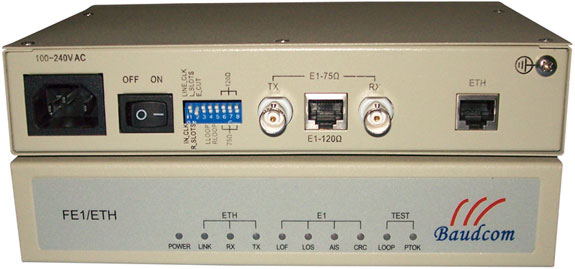
E1 to
Ethernet converter
An
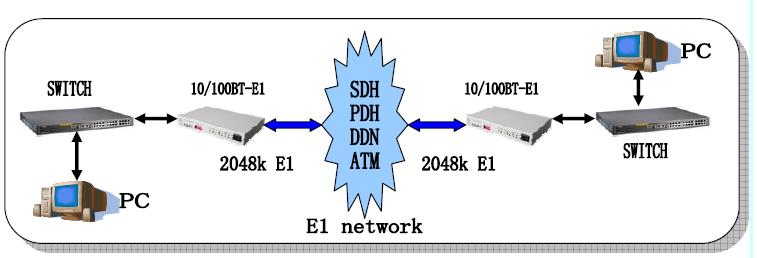
E1 Interface Converter allows the user to transport LANs over an E1 link. The
equipment can convert and transport up to 4 x Ethernet links over an E1. The
transportation can be carried out in a discreet or shared mode based on the
needs and preferences of the users.
All
the channels are carried using the same shared E1 link in the shared mode. They
are also allowed access to each other’s paths. This mode is preferred by users
who want all the links transported to share their bandwidth resources
optimally. Obviously, discretion is not of much consequence in this operation.
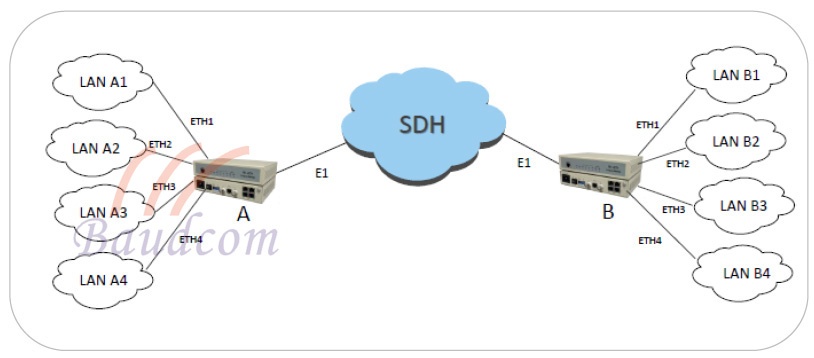
Share mode
application: Each LAN can view and
communicate with other LANS, for example LAN A1 can communicate with LAN A2 LAN
A3 LAN A4 and LAN B1 LAN B2 LAN B3 LAN B4
In
the discreet mode (also called isolation mode), all the channels are
transported using the same E1 link. However, in this case, it is done without
providing access to each other’s paths. There is no sharing involved. The mode
is available to those users who want all the links to maintain discretion
without allowing access to each other.
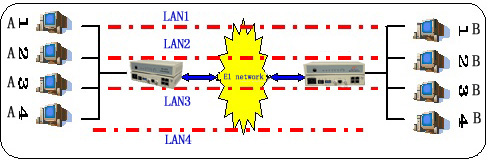
Isolation
mode
LAN A1 can
only communicate with LAN B1;The LAN A2 only can communicate with LAN B2;
LAN A3 only can communicate with LAN B3; LAN A4
only can communicate with LAN B4;
This
equipment may be used for the following purposes:
• For bridging LANs over an existing E1
network
• For extending Ethernet Networks using E1
landline based telecom infrastructure
• In telecom network of E1 for transporting
Ethernet data
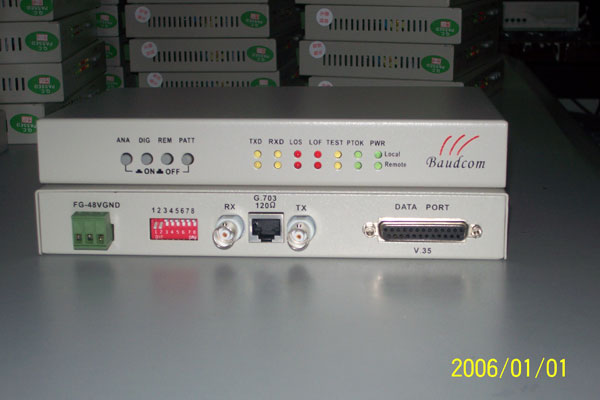
E1 to v.35 Converter
The E1 to v.35 converter
comes with one E1 interface and one v.35 interface for framed or unframed E1
interface transferring to v.35 interface. The project can be assisted by the
inter-set loop test feature. It is helpful for converting the E1 line to v.35.
It can detect if the device’s power is turned off or if the transmission fiber
connection is not working properly. They indicate the same on the LED. It
complies with the protocol ITU-T V.35, G.703, G.704. The applications include lease
line connectivity with V35 router and v.35 router back-to-back connectivity. It
can also help connect any v.35 device with an E1 interface.
E1 to RS232 Converter
This device helps in
converting the G703/E1 and RS232 interface. It collects data from the data
terminal equipment and converts it into an E1 line. It can also connect the
data logger, RTU, and PC to the E1 converter. The key features include support
for framed and unframed E1, loop back tests, and internal and external recovery
clocks.
How Does the E1 Converter
Work?
The E1 interface employs a
differential system and uses various receive and transmit and pairs.
The two coaxial cables ending in the BNC
connectors are the most commonly used formats for data transmission. Twisted
pairs with RJ-48C connector is also used in many applications.
Uses of E1 Interface Converter
You can use these
converters for a variety of applications. You can send v.35 or RS-232 or
Ethernet and even videos using multiple E1s. There is a solution available for
all your E1 conversion needs.
Shanghai Baudcom Communication
Device Co., Ltd is a trusted manufacturer of the world’s best E1
interface converters. You can find everything you are looking for
here is at highly competitive prices.


