
Voice over Internet Protocol Gateway, often
mentioned only as VoIP gateway, is a hardware device used in the conversion of
analog telephony traffic signal into digital packets data. The VoIP gateway
arrange and encrypts this converted signal into packets of data and transmitted
over an Internet Protocol (IP) network.
The article will introduce:
What is Voip Gateway?
How does Voip gateway
work?
Voip gateway types
How to choose Voip
gateway?
VoIP Gateway characteristics
The Voice over Internet Protocol (VoIP)
gateway main characteristics includes:
Signal control management;
Packetization of data;
Compression and decompression of fax and voice calls;
Call routing;
And interface of external controllers, such as network of management
system, soft switches, gatekeepers or billing system.
How does a VoIP Gateway works?
VoIP gateway are uncomplicated devices,
that simply works as a link between the Public Switched Telephone Network (PSTN)
and the Internet Protocol (IP) network. By follow the origin of where the voice
traffic signal arises from a VoIP gateway is able to convert the voice traffic
signal into the appropriate form to be receive by the destination network,
which can be PSTN or IP.
When the analog traffic signal originates
from a PSTN, the VoIP gateway is bound to convert the analog traffic signal
into a digital signal. By using a codec this digital signal is later on
compressed and fragmented into packets of data that are transmitted over an
Internet Protocol (IP) network utilizing a signaling protocol.
When the analog traffic signal originates
from an Internet Protocol (IP) network, the VoIP gateway is bound to decompress
the digital packets in a digital signal, and after that the signal is converted
in an analog signal that is latter on sent by PSTN.
Protocols and codecs
The use of compatible protocols and codecs
is indispensable for the good operation of the VoIP system and service, since
it can play a big role in the call quality.
The
protocols assures on how the voice packet is transferred between the network.
The main VoIP protocols are: Session Initiation Protocol (SIP), which is the
standard protocol utilized in most VoIP systems and services; Cisco Skinny
Control Protocol (SCC), which is utilized in IP phones or Cisco’s Call Manager;
Media Gateway Control Protocol (MGCP), which is the older VoIP protocol not
longer utilized; and H.323, is also an old VoIP protocol, so it is also felt
into disuse widely.
The codes assures the sound quality of the
packet and it is in control of the compression of the voice stream in the
digital packet. Usually a VoIP gateway is able to supports several codecs. The
main codecs existing are: G.729 (8kbps); GSM (13Kbps); iLBC (15Kbps);
G.728 (16kbps); G.726 (16-24-40Kbps); G.722 (48-56-64kbps); and G.711 (64Kbps).
Types of Voice over Internet Protocol
(VoIP) Gateway
Initially is
important to understand that there are two main types of VoIP gateways, that
are the analog VoIP gateway and the digital VoIP gateway.
Analog
VoIP Gateway
A analog
VoIP gateway is utilized to make the connection between traditional analog
telephones and VoIP phone system, or make the connection the VoIP phone system
and the Public Switched Telephone Network (PSTN). Because of this two purpose of
the analog VoIP gateway, this gateway has two different variations, that are
the Foreign Exchange Office (FXO) and Foreign Exchange Subscriber (FXS).
FXO
Gateway
FXO gateway
is utilized to make the connection between the VoIP phone system and the Public
Switched Telephone Network (PSTN) lines.
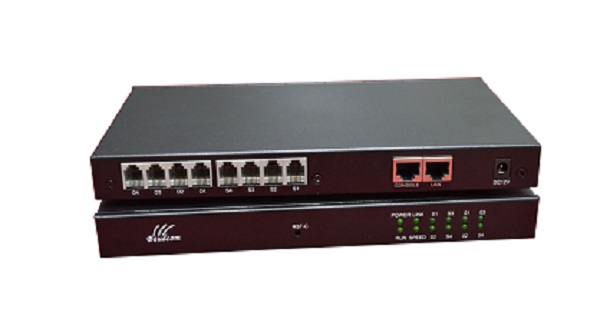
4 ports FXS/FXO Analog Voice Gateway
FXS
Gateway
FXS gateway is utilized to make the connection between the usual
telephones and fax machines and the VoIP phone system.
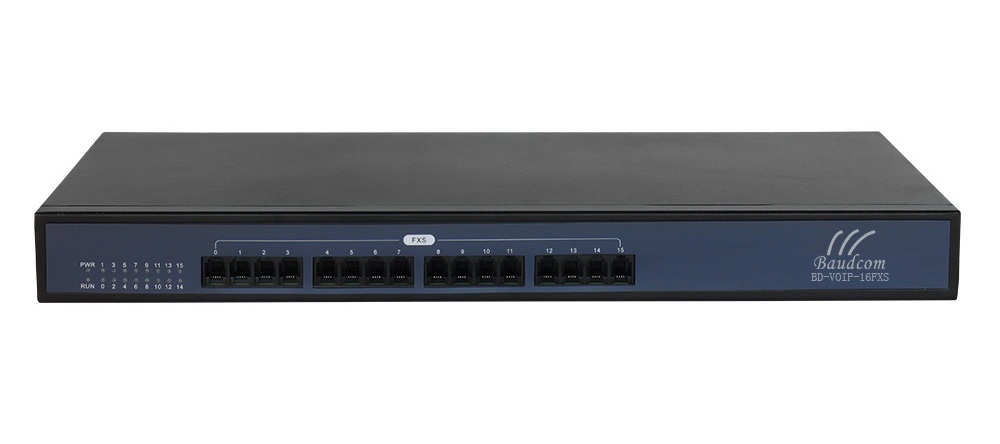
Digital VoIP Gateway
The digital VoIP gateway is utilized to make the connection between
VoIP phones lines and the digital voice lines, like E1; T1; BRI. An digital
gateway is also able to make the connection between traditional PBX system and
Internet Protocol (IP) network.
Although the analog VoIP gateway and the digital VoIP gateway
function similarities, this two gateways central difference is the interfaces
used in each connection of there numerous solution components.
Voice over Internet Protocol (VoIP) Gateway configurations
In the market you can find different types of VoIP gateways, in with
also came with different configurations according to your need.
FXO Gateways are design with configurations of 4 ports, 8 ports , 16
ports , 24 ports and 48 ports.
FXS Gateways are
design with configurations of 4 ports,8 ports ,16 ports , 24 pots and 48 ports.
Digital Gateways
are design in 1T1, 2T1, 4T1; 1E1, 2E1, 4E1; 1BRI, 2BRI and 4BRI.
What to take into consideration when
purchasing a VoIP Gateway?
Audio quality. The audio quality with lower traffic standard
congestion must be near to the digital PBX, and Heavy traffic congestion must
remain not far from the low.
Device features and configuration. It is important to analyse the configuration and extra features design in the gateway, such as caller ID for identifying in the incoming caller, automatic number identification, and interactive voice response.


