
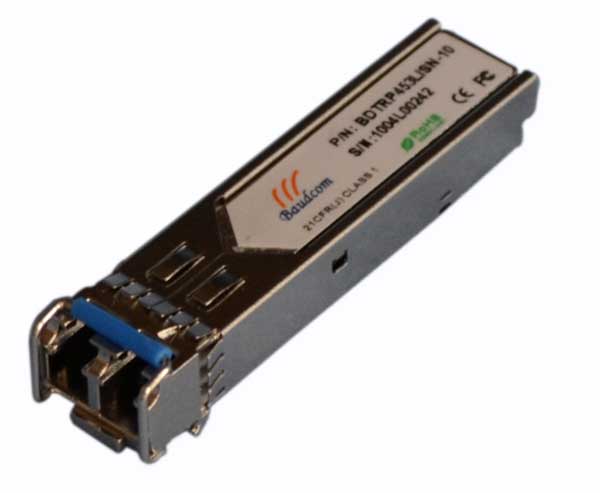
What is an SFP?
SFP stands for small form-factor pluggable.
Simply put, it is a small transceiver that can send and receive data through
optical fiber. It is a compact optical transceiver module used in
telecommunications and data communication systems. It helps to seamlessly
convert Ethernet signals into optical signals to transmit and receive data.
Moreover, the SFP module is hot-swappable, which makes it easy to adjust the
existing network without redesigning the entire cable infrastructure.
Types of SFP
Wavelength
1310/1550 nm = Single Mode (9/125 μm)
850/1300 nm = Multimode (50/125 μm)
Bandwidth
SFP modules support up to 4.25 Gbps.
SFP+ modules (enhanced small form-factor
pluggable) support up to 16 Gbps.
SFP28 modules can handle 25 Gbps over one
channel.
Applications of SFP
In the field of fiber optics, applications cover
anything that may involve high-speed and/or long-distance cables.
High-definition audio transmission and reception, passive optical networks
(PON), multiplexing and simplex networks are the most common uses of this technology.
The variability of SFP allows it to provide modules for any of these
connections, and offers a range of options in terms of cost, speed, range, and
accessibility.
Where is an SFP port located?
You can find SFP ports on network devices (such
as switches, servers, routers, network interface cards, or computers). Most
switches used in large computer network applications have at least two SFP
ports. These switches are sometimes called SFP switches.
How to Use It?
When the SFP port on the switch is embedded in
an optical SFP module with an optical port, an optical fiber link (SMF optical
fiber/MMF optical fiber) with a duplex LC connector is required to support the
connection.
SFP ports and their corresponding SFP modules are used to facilitate seamless, high-speed data communications or
long-distance telecommunications connections in various applications. They are
commonly used to connect one gigabit network switch to another network switch,
which in turn increases the size of the network and improves the functionality
of the network. This is helpful in military, industrial, and commercial
environments, where many devices in a wide area require wired, high-speed, and
reliable connections.
Conclusion
SFP ports are an important part of high-speed
telecommunications and data communications, especially in large-scale network
environments. It is important to remember that the ultimate goal of SFP ports
is to facilitate a reliable, wired, high-speed connection between two devices
via copper or fiber optic cables.
Baudcom offers all
kinds of fiber optic SFP modules. For more information, please visit Baudcom.
Related article:
What determines a link in SFP modules?
Top 5 Most Common Fiber Optic Transceiver Types Used in 2025


